“Now We Know What It Really Is”: RFMF Officer Reflects on Transformative FWCC Training
18 Jun, 2026
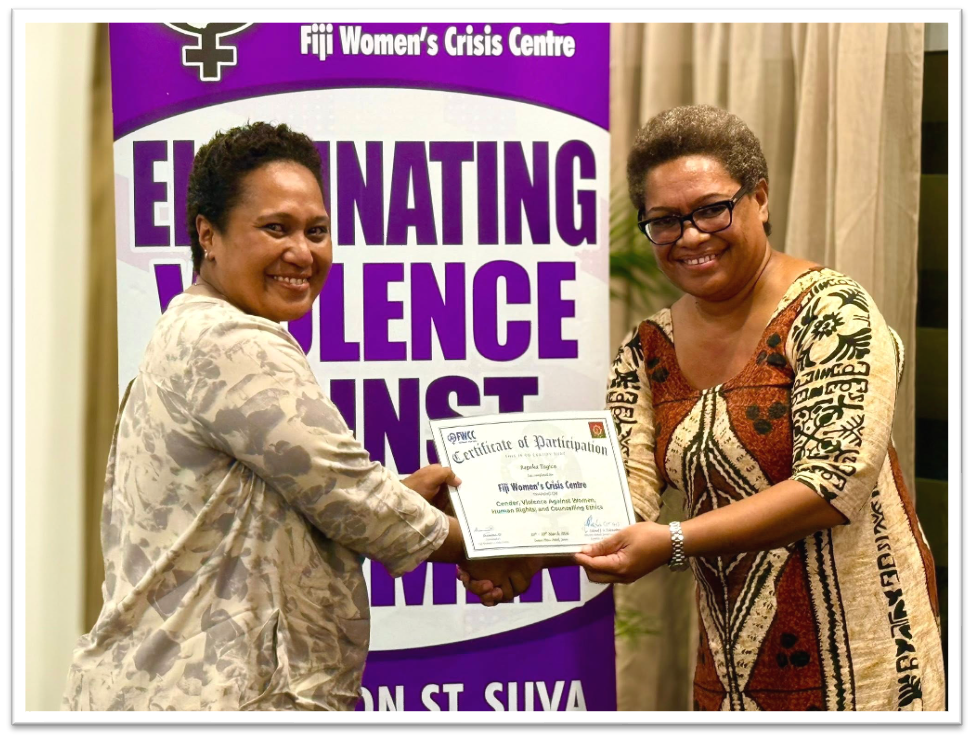
For Warrant Officer Class Two Repeka Tagica, the message from a week-long Fiji Women’s Crisis Centre (FWCC) training was clear: violence against women and girls has been normalised and excused.
“The only words that kept coming back to me were gender sensitisation,” she said. “And what better way to understand this than to come and attend this kind of training.”
WO2 Tagica was among 35 Gender Focal Points from the Republic of Fiji Military Forces (RFMF) who completed an intensive five-day programme led by FWCC in Suva. The training focused on gender, human rights, violence against women and girls, and basic counselling ethics, but more importantly, it confronted deeply rooted beliefs that continue to sustain violence.
For Tagica, a woman working within a traditionally male-dominated institution, the shift was personal.
“This workshop has changed my perspective,” she said. “It challenges what I grew up believing about what a girl or a boy is supposed to be.”
That shift – from acceptance to critical awareness – is at the heart of FWCC’s work. For decades, the Centre has pushed back against narratives that minimise violence, instead insisting that violence against women is a serious human rights violation that demands institutional accountability and societal change.
“This training helped me understand the issues we are actually facing in our country,” Tagica said. “Not only that, but also within our institution.”
Participants were taken through the root cause of violence, the role of power and control, and the responsibility of institutions like the RFMF to respond ethically and effectively. The training is part of Fiji’s National Action Plan to Prevent Violence against All Women and Girls, which calls for stronger systems, coordinated responses, and zero tolerance for violence.
For Tagica, whose work involves investigating and monitoring such cases, the training created something that had previously been missing: a network of informed and committed officers across the force.
“I know who I can work with now to fight against violence against women and girls,” Tagica said. “This will not only help our institution, but it can also help us in our very own homes.”
This matters. Because ending violence is not the responsibility of one unit, one officer, or one organisation – it requires coordinated, informed action across all levels of an institution.
That clarity – naming violence, understanding the root cause, and refusing to excuse it – is a critical step toward change.
Tagica also acknowledged the leadership behind the training, expressing gratitude to the RFMF Gender Advisor and FWCC for making the programme possible.
“It has enlightened us,” she said.
FWCC has long maintained that awareness alone is not enough – it must lead to action, accountability, and sustained institutional commitment. Trainings like this are part of that broader effort: equipping those in positions of power with the knowledge and responsibility to respond to survivors with dignity, and to challenge the systems that allow violence to persist.
As Tagica’s reflections make clear, the shift has begun.
The question now is whether institutions – and the individuals within them – will act on what they know.
Ends